
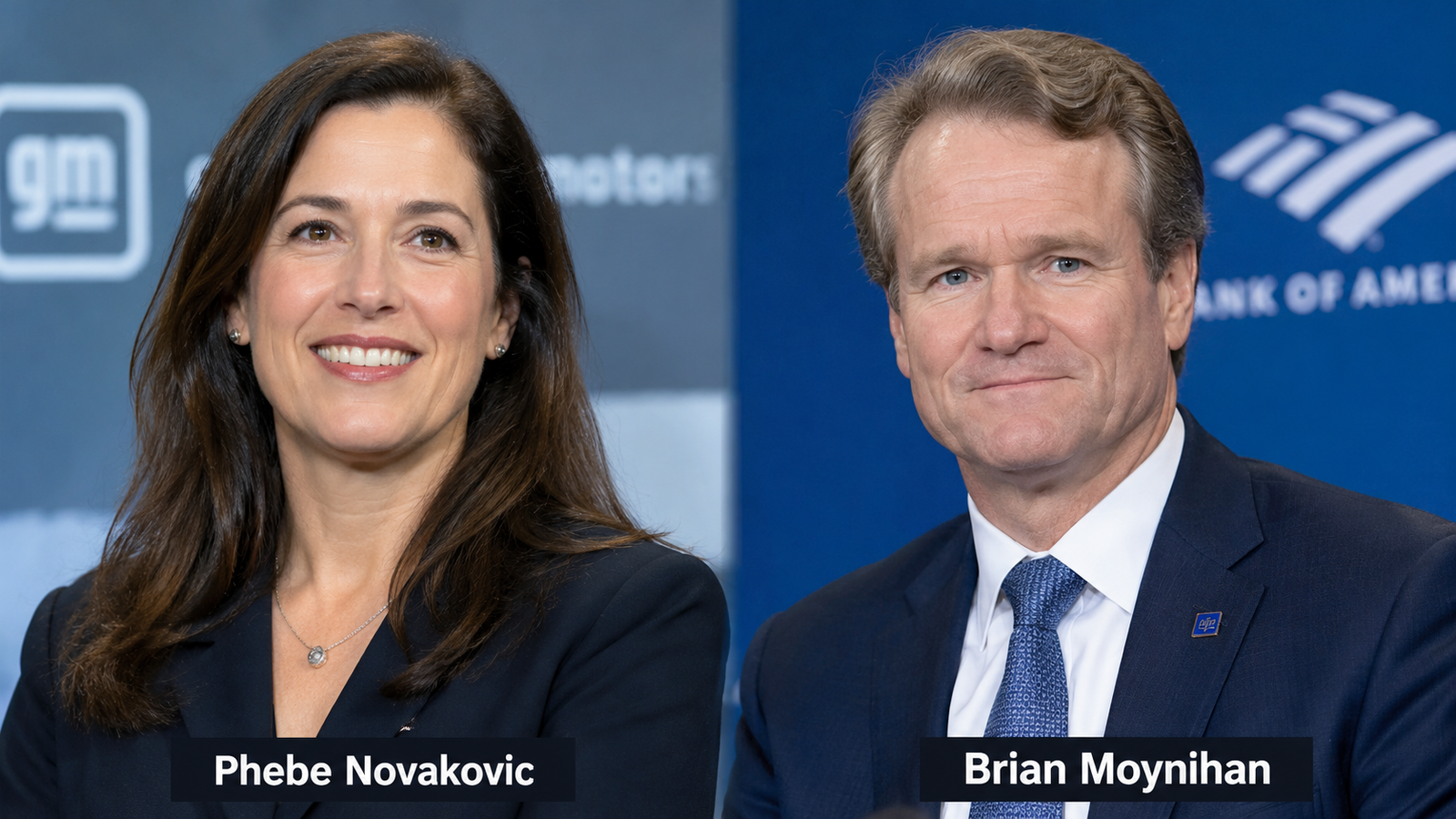
What does it take to run a huge organization for more than a decade? Most of us can’t even picture it. Still, we can learn plenty by studying people who’ve done it. Phebe Novakovic and Brian Moynihan make a great pair to compare. One came up through intelligence work and defense. The other rose through banking and then steered through a crisis. Their paths look nothing alike, yet they share habits any manager can borrow.
Here’s what you’ll find below: how each leader built a career, how they run things, and what you can use in your own work. We’ll also touch on the latest leadership news around both.
Why Phebe Novakovic and Brian Moynihan Make a Useful Comparison
Comparing leaders only works when they differ in useful ways. These two do.
Novakovic leads a large aerospace and defense contractor. Moynihan, on the other hand, runs one of the biggest banks in the United States. Their industries also follow different rules, serve different customers, and run on different clocks. A defense program can last decades. A bank’s results show up every quarter.
Because the gap is so wide, the overlap stands out. Both have held the top job for a very long time. Moynihan took over in 2010, and Novakovic became chief executive in 2013. Many CEOs last only a few years, so that staying power says something.
Also, both currently serve as chairman and CEO at the same time. That dual role gives them real influence over the board’s agenda. Critics sometimes question it, while supporters argue it keeps decisions fast and clear.
Think of them as two chefs running very different kitchens. One cooks for a few demanding customers on long orders. The other serves millions of guests every day.
Career Paths That Couldn’t Look More Different
The careers of Phebe Novakovic and Brian Moynihan began in separate worlds. Novakovic’s résumé reads like a spy novel with a spreadsheet attached. She worked as an operations officer at the Central Intelligence Agency and spent time at the Department of Defense. Then she moved into the private sector and joined her current employer in 2001. She also earned an MBA at Wharton.
Moynihan, however, took a banking route. He ran consumer and small business banking before the board named him chief executive in 2010. At that point, the bank was still recovering from the 2008 financial crisis. So his first job wasn’t to dream big. It was to fix the basics.
For instance, he sold off 23 non-core businesses in his first six quarters. He also worked to blend the investment and wealth units into the bank’s existing retail network.
Think of it like cleaning out a garage. You can’t park the car until you haul out the junk.
Leadership Style: Quiet Focus Versus Steady Turnaround
Novakovic famously avoids the spotlight. Reporters rarely get her on the record, and she doesn’t chase headlines. However, the numbers do the talking. Revenue reached $47.7 billion in 2024, up nearly 13% from the year before.
Her board has praised her vision, her integrity, and her care for employees. That mix suggests a leader who values discipline and culture equally. Besides, a low profile can protect focus. Fewer interviews mean more time for the work.
Moynihan’s approach has a name: Responsible Growth. In plain English, the bank grows only in ways it can manage without wild risks. That means steady gains instead of flashy bets. Still, analysts point out that the stock hasn’t always matched top rivals, so the approach comes with trade-offs.
Phebe Novakovic and Brian Moynihan also differ in pace. Defense programs reward patience because contracts and builds stretch across years. Banking, on the other hand, reacts to interest rates and customer habits within weeks. As a result, each leader tunes their routine to a different rhythm.
Meanwhile, a shared thread runs through both styles. Each leader prefers predictable execution to drama. Which approach would you rather work under?
What Managers Can Learn From Phebe Novakovic and Brian Moynihan
You don’t need a corner office to use these ideas. Small teams and solo businesses can borrow them too.
Give a Strategy Time to Work
Both leaders stayed in one seat long enough to see their plans play out. Quick pivots feel exciting, but they rarely build anything lasting. For example, if you change your marketing plan every month, you’ll never learn what actually works.
Fix the Basics Before Chasing Growth
Moynihan’s early years show this well. He cleaned up the balance sheet first, and growth followed later. So before you add a new project, ask yourself what’s quietly broken.
Match Your Visibility to Your Goals
Novakovic stays out of the spotlight, while many executives embrace it. Neither choice is wrong. Still, you should decide on purpose how much attention your work needs.
Succession Plans of Phebe Novakovic and Brian Moynihan
Great leaders think about their exit long before it happens. Think of a relay race. The handoff matters more than the sprint.
Novakovic’s board announced on October 7, 2026 that president Danny Deep will become CEO on January 1, 2027. She will stay on as executive chairman after thirteen years as chief executive.
Moynihan has taken a slower path. In 2025, he named two co-presidents and gave the finance chief a bigger title. Analysts quickly called it a three-way race. He has said he plans to lead through the end of the decade.
As a result, you can see two methods. One sets a firm date, and the other builds a bench and waits.
Mistakes to Avoid When Studying Famous CEOs
Reading about Phebe Novakovic and Brian Moynihan is fun, but it’s easy to draw the wrong lessons. Watch for these traps.
Copying Style Without Context
A habit that works in defense contracting may flop in a bakery. Always ask why a choice worked before you copy it.
Ignoring Survivorship Bias
We hear from winners, not from the leaders who tried the same moves and failed. Therefore, treat every success story as one data point, not a rulebook.
Mistaking Fame for Skill
Loud leaders get more coverage. Quiet ones, like Novakovic, often get less. However, coverage isn’t the same as results.
FAQs
Who are Phebe Novakovic and Brian Moynihan?
Novakovic is the chairman and CEO of a major aerospace and defense contractor. Moynihan is the chairman and CEO of one of America’s largest banks. Both are known for long tenures.
How long have they led their organizations?
Moynihan has been CEO since 2010. Novakovic has served since 2013. Meanwhile, her role will change on January 1, 2027.
Is Novakovic retiring?
Not fully. She’s moving from CEO to executive chairman, so she’ll stay involved after the handoff.
What can beginners learn from them?
Start with patience, clear priorities, and succession thinking. Also, remember that every leader’s style fits a specific situation.
Conclusion
Phebe Novakovic and Brian Moynihan prove that there’s no single recipe for lasting leadership. One favors a quiet profile and steady discipline. The other favors a patient, step-by-step rebuild. Still, both stay focused, think long term, and plan for what comes next. Take one idea from this article and test it in your own work this week. Then see what happens.




Leave a Reply