
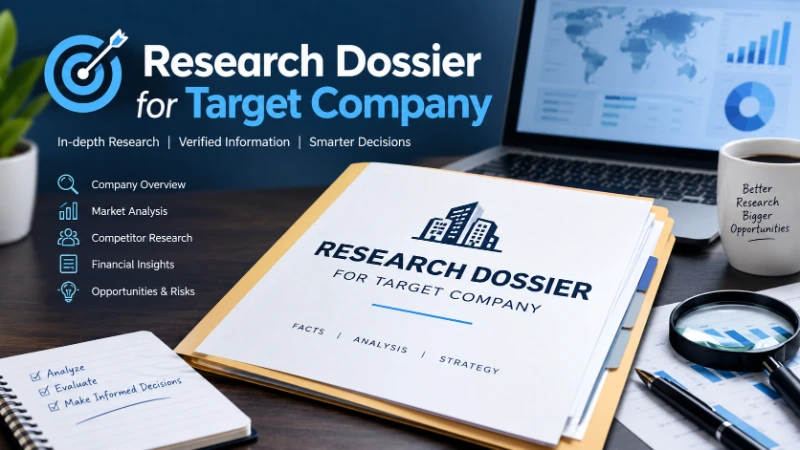
You have a call with a VP tomorrow, yet all you know comes from the homepage. That is a risky place to start. However, a solid research dossier for target company outreach fixes the problem in about an hour, and as a result, every conversation gets sharper.
What Is a Research Dossier for Target Company Outreach?
A dossier is one organized document that explains who a company is, how it earns money, what worries its leaders, and where you fit. In other words, it is not a folder of random bookmarks. Likewise, it differs from a standard company profile, because a profile describes while a dossier recommends.
Therefore, a research dossier for target company accounts always ends with a clear action: what to say, whom to contact, and what to avoid.
Who Benefits From a Company Dossier
Sales reps use dossiers most, but they are far from the only audience. For example, a job seeker who knows about a firm’s recent product delay can ask a smarter interview question than the other candidates. Similarly, these groups gain real value:
- Business development teams, because they need warm introductions
- Investors and analysts, since early screening saves money
- Consultants, because a sharp pitch wins projects
- Recruiters and journalists, who also need quick context
What to Include in Your Research Dossier for Target Company
First, think of the dossier as a set of short, focused sections. Besides that, each section should answer a question you will face in the conversation.
Company snapshot
Start with the founding year, headquarters, headcount, ownership, and core products. However, keep this to five or six lines. Also, add one sentence on how the company describes itself, because its own language gives you the best messaging material.
Financials and growth signals
Public companies make this easy through annual reports and earnings calls. Private firms, on the other hand, need more detective work. For instance, funding rounds, revenue estimates, and LinkedIn headcount growth all hint at momentum. As a result, you can tell a company that just raised a Series B from one that is cutting costs.
Leadership and decision-makers
Next, map the people, not just the logo. Note who owns the budget, who influences the decision, and who might block it. Meanwhile, read their recent posts and interviews, since leaders often reveal their priorities in public.
Pain points and priorities
This section earns its place. In fact, annual letters, earnings call remarks, and job postings all expose what the company struggles with. For example, a cluster of openings for data engineers usually says more about strategy than any press release.
Competitors and market position
Moreover, list three to five direct rivals and note where your target wins or loses. As a result, you can anticipate objections before anyone raises them.
Trigger events
New executives, acquisitions, launches, and layoffs all create openings. Therefore, flag anything from the last 90 days. In fact, timing often matters more than the pitch itself.
Risks and red flags
Most guides skip this part, yet it saves time. Check for lawsuits, regulatory trouble, negative employee reviews, and shaky financials. Consequently, if you plan to partner or invest, these signals can change your whole approach.
Your angle and next step
Finally, write a short paragraph: why this company, why now, and which person you will contact first. Otherwise, the research just sits there.
Where to Find Reliable Information
Fortunately, you do not need expensive software to start. In fact, a research dossier for target company only works when the data is trustworthy, and free sources cover most needs:
- Company website: first, check product pages, case studies, and the About section
- Investor pages and SEC filings: also, use these for audited numbers on public firms
- LinkedIn: additionally, track org charts, role changes, and hiring speed
- Review sites like G2 and Glassdoor: meanwhile, scan them for customer and employee complaints
- Google Alerts: then, set one for the company name
- Earnings call transcripts: finally, read them for unfiltered executive priorities
Job postings deserve special attention. For example, when a posting asks for experience with a specific platform, you learn the company’s tech stack for free.
A 60-Minute Workflow for Building Your Research Dossier for Target Company
Time limits keep research from turning into procrastination. Therefore, try this order:
- Minutes 0-10: First, read the homepage and product pages, then write the snapshot.
- Minutes 10-25: Next, scan filings, funding news, and growth indicators.
- Minutes 25-40: Then, map the leadership and pick two likely contacts.
- Minutes 40-50: After that, review job postings, reviews, and recent news for pain points and risks.
- Minutes 50-60: Finally, write your angle, three talking points, and one question to ask.
However, if the hour ends and data is still missing, stop. After all, perfect information never arrives, so a good-enough dossier beats a late one.
A Simple Template You Can Copy
Open a blank page, then use these headings. In practice, your research dossier for target company works best as a single page.
- Snapshot: what they do, their size, and their location
- Money: funding, revenue, and growth direction
- People: key contacts and their priorities
- Pain points: three problems you can see
- Competitors: who they fight
- Triggers: recent news worth mentioning
- Risks: anything that gives you pause
- Angle: your opening line and your goal
Usually, one page is enough. In fact, once a dossier passes two pages, nobody rereads it before the meeting.
Mistakes That Weaken a Dossier
Unfortunately, people repeat the same errors. Even a well-built research dossier for target company can fail, so watch for these.
Collecting without concluding. Twenty facts do nothing without a recommendation. Therefore, always finish with the “so what.”
Trusting one source. A funding figure on a blog may be outdated. For that reason, confirm key numbers in at least two places.
Ignoring freshness. A dossier from last year can embarrass you if the CEO left in March. So check the dates, and refresh before any important contact.
Researching only the company. Meanwhile, the person you meet matters just as much. After all, their background shapes how they hear you.
Keeping Your Research Dossier for Target Company Current
A dossier is a living document. Therefore, add a “last updated” date at the top and review it before each touchpoint. For key accounts, a monthly ten-minute refresh keeps you ahead. Besides, alerts and saved searches do most of the heavy lifting, so maintenance rarely feels like work.
FAQ
1. What is a research dossier for target company analysis?
It is a structured document that gathers a company’s key facts, people, challenges, and opportunities in one place. Unlike a basic profile, however, it ends with a recommended approach for engaging that company.
2. How long should a company dossier be?
One to two pages works for most situations. Strategic accounts can justify more, but longer documents usually go unread.
3. What sources are best for researching a company?
Start with the company website, SEC filings, LinkedIn, job postings, and news alerts. In addition, review sites add useful context on customers and employees.
4. How do I research a private company with little public data?
Look at funding announcements, hiring trends, leadership interviews, and customer reviews. Together, these indirect signals reveal growth and priorities.
5. How long does it take to build one?
A focused dossier takes about 60 minutes. However, strategic accounts may need two to three hours.
6. How often should I update it?
Refresh it before every major contact, and review active accounts monthly. Likewise, fast-moving companies may need more frequent checks.
The Takeaway
The best dossier is the one you actually use. So set a timer, follow the workflow above, and end every document with a clear angle. Try a research dossier for target company on your next prospect, and you will notice the difference within the first five minutes of the call. Then save your template, because the next one will take half the time.

Leave a Reply